4.3 Solving it numerically — particle in a box¶
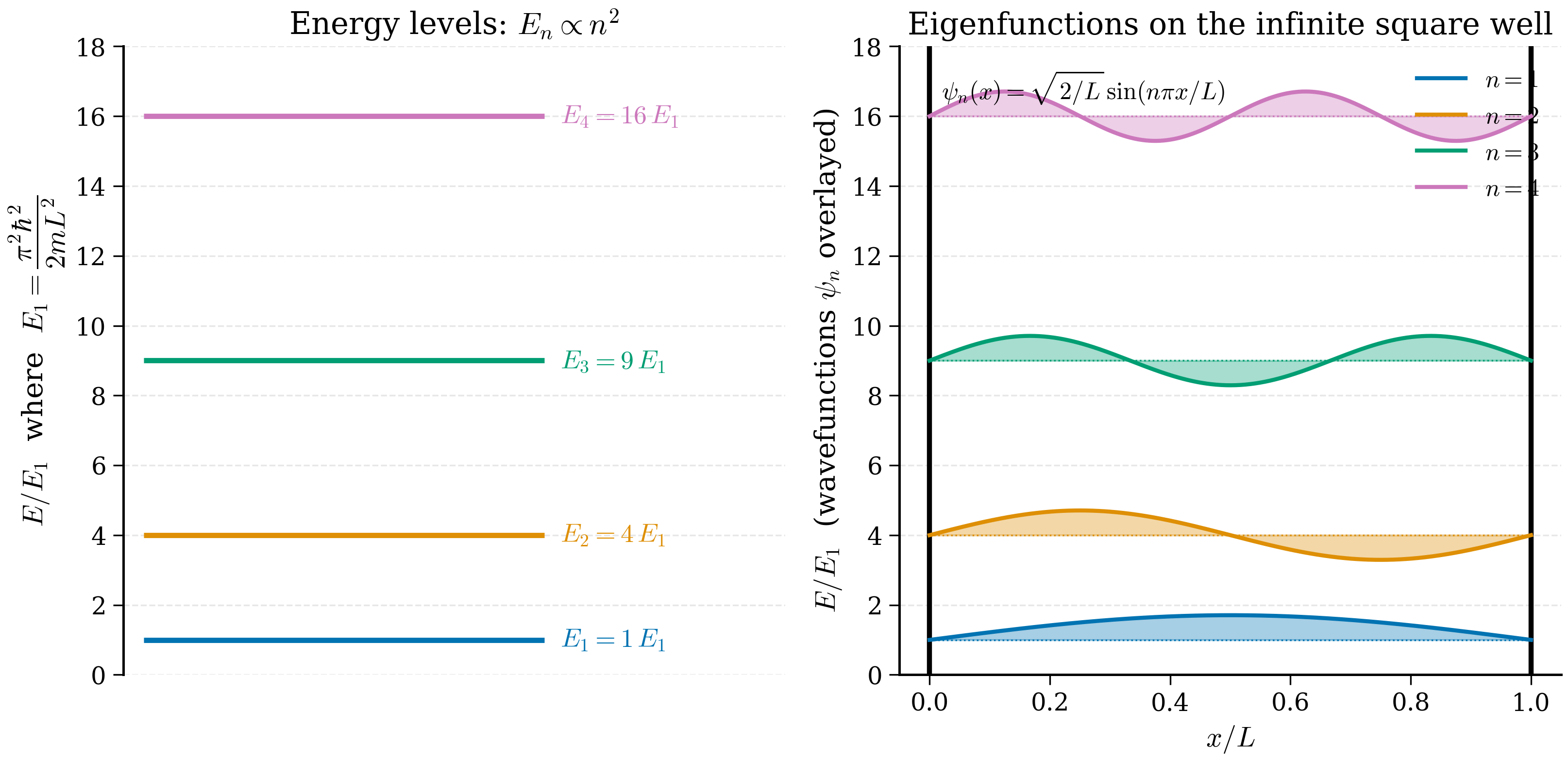
We have a postulate (the Schrödinger equation) and a framework (Hermitian operators, eigenvalue problems, bra-ket notation). It is time to solve something. We pick the simplest non-trivial problem in quantum mechanics: a single particle confined to a one-dimensional region, with infinite potential walls. This is the "particle in a box", and it is the quantum analogue of a guitar string fixed at both ends.
The motivation is partly pedagogical and partly practical. Pedagogically, the box is the first place a reader meets quantised energies emerging from a calculation rather than as a postulate — the discreteness is forced on us by the boundary conditions, not put in by hand. Practically, the box is a surprisingly good caricature of an electron in a quantum well (a thin semiconductor layer) or in a long conjugated molecule like a polyene, and one can already make order-of-magnitude predictions about light absorption from this model.
We will solve the problem twice: once analytically with paper and pencil, and once numerically by turning the Hamiltonian into a matrix and diagonalising it. The numerical method we develop here — finite differences plus scipy.linalg.eigh — is exactly the method we will reuse in §4.4 for the harmonic oscillator and which, in spirit, underlies modern plane-wave electronic-structure codes.
4.3.0 Classical preview: a ball in a box¶
Before doing any quantum mechanics, take a moment to remember what the classical version of this problem looks like, because the contrast is illuminating.
A classical point particle of mass \(m\) is placed inside a 1D region \(0 < x < L\) with rigid walls at the endpoints. Inside, no force acts: the particle moves at constant velocity. At each wall it undergoes an elastic collision that reverses its momentum. The motion is a perfectly periodic back-and-forth at constant speed.
What can we say about this system?
- Energy is continuous. The particle has kinetic energy \(E = \tfrac12 m v^2\) for any \(v \geq 0\) we like. There is no minimum energy: a ball sitting at rest in the middle of the box has \(E = 0\).
- Position is uniform on average. Time-averaged over many bounces, the probability density of finding the ball at any \(x \in (0, L)\) is uniform, \(\rho_{\mathrm{cl}}(x) = 1/L\). The ball spends equal time at every point because it moves at constant speed.
- No interference. There is no analogue of a "node" in the probability density.
Now contrast: quantum mechanically, the same setup with the same walls produces a discrete spectrum, a non-zero ground-state energy, and probability densities \(|\psi_n(x)|^2 = (2/L)\sin^2(n\pi x/L)\) that oscillate between zero (nodes) and a maximum \(2/L\). The classical uniform distribution is recovered only as an average over many neighbouring quantum states — the correspondence principle in action.
Standing waves are the right intuition
A musician knows what frequencies a string can sound: only those whose half-wavelength fits an integer number of times into the string length. A quantum particle in a box is exactly the same constraint applied to its de Broglie wave. The wavefunction has to fit — and only certain wavelengths fit, which is why only certain energies are allowed. The discreteness is forced by geometry, not postulated.
With this intuition in place, the analytical solution that follows is no more mysterious than the modes of a guitar string.
4.3.1 The model¶
What problem are we solving?
We want the allowed energies of a single quantum particle trapped between two impenetrable walls a distance \(L\) apart, and the wavefunction that goes with each energy. "Allowed" is the key word: classically the particle could have any energy at all, but quantum mechanically only a discrete ladder of energies will turn out to be possible. Our task is to find that ladder — the numbers \(E_1, E_2, E_3, \dots\) — directly from the Schrödinger equation, with no quantisation put in by hand. We then redo the whole calculation on a computer, so that the same code will later solve problems we cannot do with pencil and paper.
Plain-language version
A guitar string fixed at both ends can only vibrate at certain frequencies, because a half-wavelength has to fit a whole number of times into the string. A quantum particle in a box is the identical idea applied to its de Broglie wave: the wavefunction must vanish at both walls, so only waves with the right wavelengths "fit", and only those waves are allowed. Each allowed wave carries a definite energy. That is where the discrete energy ladder comes from.
Before the symbols arrive, here is a guide to every one used in this section. Refer back to it whenever a letter looks unfamiliar; for the words (wavefunction, eigenvalue, operator, boundary condition) see the beginner glossary.
| Symbol | Meaning | Units (SI) |
|---|---|---|
| \(x\) | position inside the box, \(0 \le x \le L\) | m |
| \(L\) | width of the box (wall-to-wall distance) | m |
| \(m\) | mass of the particle | kg |
| \(V(x)\) | potential energy as a function of position | J |
| \(\psi(x)\) | wavefunction; \(\lvert\psi\rvert^2\) is the probability density | m\(^{-1/2}\) (1D) |
| \(E\) | energy eigenvalue (an allowed energy) | J |
| \(\hbar\) | reduced Planck constant, \(1.055\times10^{-34}\) | J s |
| \(k\) | wavenumber, \(k = 2\pi/\lambda\) | m\(^{-1}\) |
| \(n\) | quantum number labelling the state, \(n = 1,2,3,\dots\) | dimensionless |
| \(A,\,B\) | amplitudes (integration constants) in the general solution | m\(^{-1/2}\) |
| \(A_n\) | normalisation constant of state \(n\) | m\(^{-1/2}\) |
Consider a single particle of mass \(m\) in one dimension, with potential
Inside the box the particle is free; outside, the infinite potential forbids any wavefunction amplitude. Continuity of \(\psi\) therefore demands
Inside the box the time-independent Schrödinger equation (4.2.6) reads
4.3.2 Analytical solution¶
We solve (4.3.3) step by step, naming every move.
Why this step? — five-step solution skeleton
The following derivation has a structure that recurs in every 1D bound-state problem: (i) solve the ODE in regions where \(V\) is constant; (ii) apply continuity at boundaries to determine the constants; (iii) apply the other boundary condition to get the eigenvalue condition; (iv) normalise; (v) read off energies and wavefunctions. Memorise the five steps; we will use the same template for the harmonic oscillator (§4.4), for tunnelling problems (Chapter 11), and for the radial equation of the hydrogen atom in any textbook.
Equation (4.3.3) is a linear second-order ODE with constant coefficients — the same equation that governs a simple harmonic oscillator in classical mechanics, with the spatial coordinate playing the role of time. Define
so that (4.3.3) becomes \(\psi'' + k^2 \psi = 0\). The general real solution is
Full derivation: where (4.3.5) comes from
Why is (4.3.5) the general solution, and why does \(k^2 \equiv 2mE/\hbar^2\) rearrange (4.3.3) so cleanly? Take it one line at a time.
Start from the time-independent Schrödinger equation inside the box, equation (4.3.3):
Multiply both sides by \(-2m/\hbar^2\) to isolate the second derivative:
The combination \(2mE/\hbar^2\) is a single positive number (we expect \(E>0\) for a confined free particle), so it is natural to give it a name. Define \(k^2 \equiv 2mE/\hbar^2\), i.e. \(k = \sqrt{2mE}/\hbar\). Then the equation reads
This is the equation "what function equals minus a constant times its own second derivative?". Two independent functions do this: \(\sin(kx)\) and \(\cos(kx)\), because
A second-order linear ODE has exactly two independent solutions, and every solution is a linear combination of them. Hence the general solution is
for arbitrary constants \(A\) and \(B\), which is (4.3.5). (Equivalently one could write \(\psi = C\,e^{ikx} + D\,e^{-ikx}\); the sine/cosine form is the same thing rewritten with \(e^{\pm ikx} = \cos kx \pm i\sin kx\), and is more convenient here because our boundary conditions are real.)
Common misunderstandings
- \(k\) is not an independent free parameter we may set to anything. Through \(k^2 = 2mE/\hbar^2\) it is tied to the energy \(E\). Fixing the allowed \(k\) values (next) is fixing the allowed energies.
- The constant \(E\) is the eigenvalue (one number); \(\psi(x)\) is the eigenfunction (a whole function). They come as a pair. Do not confuse "the energy of state \(n\)" (\(E_n\), a number) with "state \(n\)" (\(\psi_n\), a function) — a beginner error we return to below.
- We have assumed \(E>0\) so that \(k\) is real. A bound state of this potential cannot have \(E<0\): with \(V=0\) inside, \(E<0\) would force \(k\) imaginary and \(\psi\) a sum of growing/decaying exponentials, which cannot vanish at both walls except trivially.
Step-by-step: how two boundary conditions quantise the energy
Two conditions, \(\psi(0)=0\) and \(\psi(L)=0\), do two different jobs. Keep them separate:
- First wall, \(\psi(0)=0\). Put \(x=0\) into (4.3.5). Since \(\sin 0 = 0\) and \(\cos 0 = 1\), only the cosine survives: \(\psi(0) = A\cdot 0 + B\cdot 1 = B\). Demanding \(\psi(0)=0\) forces \(B=0\). Effect: it kills the cosine; the wavefunction must be a pure sine, \(\psi(x) = A\sin(kx)\).
- Second wall, \(\psi(L)=0\). Now \(\psi(L) = A\sin(kL) = 0\). We do not want \(A=0\) (that gives \(\psi\equiv0\) everywhere — no particle), so we need \(\sin(kL)=0\).
- Solve \(\sin(kL)=0\). The sine vanishes exactly at integer multiples of \(\pi\): \(kL = n\pi\) for \(n=1,2,3,\dots\) This is the eigenvalue condition — the single equation that selects which \(k\) (and hence which \(E\)) are allowed.
- Read off energies. From \(k_n = n\pi/L\) and \(E = \hbar^2k^2/2m\), the allowed energies are \(E_n = n^2\pi^2\hbar^2/(2mL^2)\).
The first condition fixes the shape (a sine); the second fixes the wavelength (which sines fit), and quantisation is the result of the sine having to fit a whole number of half-waves into the box.
Apply the boundary conditions. At \(x = 0\),
so \(B = 0\) and the wavefunction is a pure sine. At \(x = L\),
Either \(A = 0\) (the trivial, unnormalisable solution we discard) or \(\sin(kL) = 0\), i.e. \(kL = n\pi\) for some integer \(n\). Thus the allowed wavenumbers are
(Negative \(n\) give the same wavefunction up to an overall sign and are discarded; \(n = 0\) gives \(\psi \equiv 0\).) The corresponding energies follow from (4.3.4):
This is our first quantised spectrum. Three features deserve note.
- The energies scale as \(n^2\): the levels are not equally spaced. Adjacent gaps grow with \(n\).
- The lowest allowed energy is \(E_1 = \pi^2 \hbar^2/(2mL^2) > 0\). Even in the ground state the particle cannot be at rest, as a classical particle could. This zero-point energy is a direct consequence of the uncertainty principle: confining the particle to a region of width \(L\) forces \(\Delta p \gtrsim \hbar/L\) and hence \(E \gtrsim \hbar^2/(2mL^2)\). We will meet a closely-related zero-point energy in §4.4.
- The energies scale as \(1/L^2\): a smaller box gives more widely spaced levels. This is why nanoscale confinement (quantum dots, quantum wells) produces tunable optical properties.
The wavefunctions are
The amplitude \(A_n\) is fixed by normalisation, equation (4.2.4) in one dimension:
Using \(\sin^2\theta = \tfrac12(1 - \cos 2\theta)\),
so \(A_n^2 \cdot L/2 = 1\), hence \(A_n = \sqrt{2/L}\). The normalised eigenfunctions are
Full derivation: the normalisation integral and the constant \(\sqrt{2/L}\)
The claim is that \(\int_0^L \sin^2(n\pi x/L)\,dx = L/2\), and that therefore \(A_n = \sqrt{2/L}\). Here is every step.
The integrand. Use the power-reduction identity \(\sin^2\theta = \tfrac12(1-\cos 2\theta)\) with \(\theta = n\pi x/L\):
Integrate term by term over \([0,L]\). The constant term gives
The cosine term integrates to a sine:
Because \(n\) is an integer, \(\sin(2n\pi) = 0\) and \(\sin 0 = 0\), so this whole term vanishes. Hence
(Sanity check: \(\sin^2\) oscillates between \(0\) and \(1\) with average \(\tfrac12\), so over a length \(L\) its integral is \(\tfrac12 \times L\). The exact algebra confirms the average-value argument.)
Solve for \(A_n\). The normalisation condition \(\int_0^L |\psi_n|^2\,dx = 1\) reads \(A_n^2 \cdot (L/2) = 1\), so
We take the positive root by convention; an overall sign (or, more generally, a phase) on a wavefunction never affects \(|\psi|^2\) and so carries no physics. Notice the units work: \([A_n] = \mathrm{m}^{-1/2}\), which is exactly what a 1D wavefunction needs so that \(\int|\psi|^2dx\) is dimensionless.
One quick sanity check: the eigenfunctions are orthogonal. For \(m \neq n\),
using the standard sine-sine integral. This is the orthogonality theorem of §4.2.6 made explicit.
Full derivation: orthogonality of distinct box eigenstates
We prove that for integers \(m \neq n\),
so that \(\int_0^L \psi_m^*\psi_n\,dx = 0\). (The eigenfunctions are real, so the complex conjugate does nothing here.)
Turn the product of sines into a difference of cosines. The product-to-sum identity is
With \(\alpha = m\pi x/L\) and \(\beta = n\pi x/L\),
Integrate each cosine over \([0,L]\). For any non-zero integer \(p\),
because \(\sin(p\pi)=0\) for every integer \(p\). Apply this with \(p = m-n\) and with \(p = m+n\). Since \(m \neq n\) and both are positive integers, \(m-n\) is a non-zero integer and \(m+n\) is a non-zero integer, so both cosine integrals vanish:
Why the \(m=n\) case is different. If \(m=n\) the first term has \(p = m-n = 0\), and \(\cos 0 = 1\) does not integrate to zero — it gives \(\int_0^L 1\,dx = L\). That non-zero piece is exactly the normalisation integral \(L/2\) computed above. So the two results combine into one statement, \(\int_0^L \psi_m^*\psi_n\,dx = \delta_{mn}\): the box eigenfunctions are orthonormal. This is the concrete realisation of the general orthogonality theorem for Hermitian operators (§4.2.6): eigenfunctions belonging to different eigenvalues are automatically orthogonal.
Common misunderstandings (nodes and zero-point energy)
- Counting nodes. A node is a point strictly inside the box where \(\psi_n\) crosses zero. State \(\psi_n = \sqrt{2/L}\sin(n\pi x/L)\) has \(n-1\) interior nodes — the ground state (\(n=1\)) has none. The zeros at the walls are forced by the boundary condition and are not counted as nodes. A common slip is to label the ground state as "\(n=0\)" and expect it to have zero energy; here \(n\) starts at \(1\).
- Zero-point energy is not a mistake. The lowest energy is \(E_1>0\), not zero. A quantum particle in a box can never be perfectly at rest, unlike a classical ball that can sit motionless in the middle. This is not an artefact of the model; it is the uncertainty principle: confining the particle to width \(L\) forces a momentum spread \(\Delta p \gtrsim \hbar/L\) and hence a kinetic energy \(\sim\hbar^2/(2mL^2)\). Setting \(E=0\) would mean \(\Delta p = 0\) with the particle pinned inside the box, which the uncertainty relation forbids.
- \(\lvert\psi_n\rvert^2\), not \(\psi_n\), is the probability. The wavefunction \(\psi_n\) goes negative (it is a sine); a probability density cannot. The measurable quantity is \(\lvert\psi_n\rvert^2 = (2/L)\sin^2(n\pi x/L)\), which is everywhere \(\ge 0\) as it must be. Where \(\psi_n\) has a node, the particle is never found.
Numerical scale
For an electron (\(m_e = 9.109 \times 10^{-31}\) kg) in a box of \(L = 1\) nm, the ground-state energy is $\(E_1 = \frac{\pi^2 (1.055 \times 10^{-34})^2}{2 \cdot 9.109 \times 10^{-31} \cdot (10^{-9})^2} \approx 6.0 \times 10^{-20}\ \mathrm{J} \approx 0.376\ \mathrm{eV}.\)$ The first excited state is at \(4 E_1 \approx 1.5\) eV, and the \(1 \to 2\) transition occurs at a wavelength of \(\sim 1100\) nm — the near-infrared. Make the box 0.5 nm and the transition shifts into the visible. This is the physics of quantum-confined optical materials.
An even smaller box: \(L = 1\) Å, electron
For \(L = 0.1\) nm \(= 1\) Å — roughly the size of a hydrogen atom — the ground-state energy is $\(E_1 = (0.376\ \mathrm{eV}) \times 100 = 37.6\ \mathrm{eV},\)$ using the inverse-square scaling with \(L\). This is in the right ballpark for atomic ionisation energies (hydrogen: 13.6 eV; helium: 24.6 eV; lithium 2\(s\): 5.4 eV). The box is too crude to give numerical chemistry, but the scale is correct, which is one of the appealing features of the model.
4.3.2a Expectation values and the uncertainty product¶
The wavefunctions (4.3.9) are explicit enough that we can compute every interesting expectation value by elementary integration. This is the simplest non-trivial example of the formal machinery of §4.2 and is worth doing once in full detail.
Position¶
For state \(n\), by symmetry of \(|\psi_n|^2 = (2/L)\sin^2(n\pi x/L)\) around \(x = L/2\),
Why this step?
The integrand \(x\,\sin^2(n\pi x/L)\) is symmetric about \(x = L/2\) in the sense that letting \(x \to L - x\) and using \(\sin(n\pi(L-x)/L) = (-1)^{n+1}\sin(n\pi x/L)\) gives \(\sin^2\) unchanged. Hence \(\int_0^L (L - x)\sin^2 = \int_0^L x \sin^2\), and adding the two yields \(L\int_0^L \sin^2 = L \cdot L/2\), so \(\int_0^L x\sin^2 = L^2/4\), giving \(\langle x\rangle = L/2\). The particle is "centred" in the classical sense, independent of \(n\).
For \(\langle x^2\rangle_n\), use \(\sin^2 u = (1 - \cos 2u)/2\):
The first term comes from \(\int_0^L x^2\,dx/L = L^2/3\) (the classical answer for a uniform distribution); the second term, the integral of \(x^2 \cos(2n\pi x/L)\), evaluates by twice integration by parts to \(L^3/(2 n^2\pi^2)\), giving the negative correction.
Full derivation: the \(\langle x^2\rangle\) integral by parts
We evaluate
and show \(J = L^3/(2n^2\pi^2)\). Write \(a \equiv 2n\pi/L\) for brevity, so \(J = \int_0^L x^2\cos(ax)\,dx\).
First integration by parts (\(u=x^2\), \(dv=\cos(ax)\,dx\), so \(du = 2x\,dx\), \(v = \sin(ax)/a\)):
At \(x=L\), \(\sin(aL) = \sin(2n\pi) = 0\); at \(x=0\) the term is \(0\). So the boundary term vanishes and
Second integration by parts (\(u=x\), \(dv=\sin(ax)\,dx\), so \(du=dx\), \(v=-\cos(ax)/a\)):
The remaining integral \(\int_0^L\cos(ax)\,dx = [\sin(ax)/a]_0^L = 0\) again (since \(\sin(aL)=\sin(2n\pi)=0\)). The boundary term at \(x=L\) is \(-L\cos(aL)/a = -L\cos(2n\pi)/a = -L/a\) (because \(\cos(2n\pi)=1\)), and at \(x=0\) it is \(0\). Hence
Combine. Substituting back,
Finally,
which is (4.3.E1).
The variance is therefore
In the limit of large \(n\), \((\Delta x)_n^2 \to L^2/12\) — exactly the variance of a uniform distribution on \([0, L]\), recovering the classical result. The correspondence principle works.
Momentum¶
For momentum, integrate by parts:
since \(\int_0^L \sin\cos = 0\). The wavefunction is a standing wave — equal admixture of left- and right-moving plane waves — so the average momentum is zero, as it must be by symmetry.
For \(\langle p^2\rangle_n\) use \(\hat p^2 \psi_n = -\hbar^2 \psi_n''\) together with the eigenvalue equation \(\hat H\psi_n = E_n\psi_n\) (and \(\hat H = \hat p^2/2m\) inside the box):
So \((\Delta p)_n^2 = \langle p^2\rangle_n - 0 = n^2\pi^2\hbar^2/L^2\) and \((\Delta p)_n = n\pi\hbar/L\).
The uncertainty product¶
Combining,
For \(n = 1\): \((\Delta x)(\Delta p) \approx 0.568\,\hbar > \hbar/2\). The bound is satisfied, with about 14% slack. For \(n = 2\): \((\Delta x)(\Delta p) \approx 1.67\,\hbar\). The product grows linearly with \(n\) at large \(n\) — higher excited states are more "uncertain" in both position (which approaches uniform) and momentum (which scales as \(\hbar k_n \propto n\)).
The lower bound is not saturated
Heisenberg's inequality is saturated only by Gaussian wavepackets, which the box eigenstates are not. The particle-in-a-box ground state is a half-sine, which has a steeper position cut-off than a Gaussian and therefore a slightly larger \(\Delta p\) for the same \(\Delta x\). Saturation will appear naturally in the harmonic oscillator ground state of §4.4 — a Gaussian.
Pause and recall
Before reading on, try to answer these from memory:
- Which boundary condition forces the wavefunction to be a pure sine, and which one then quantises the allowed wavenumbers \(k_n\)?
- Why is the ground-state energy \(E_1\) strictly positive, and how does this zero-point energy follow from the uncertainty principle?
- The energies scale as \(n^2/L^2\) — what does the \(1/L^2\) dependence imply for the optical properties of a quantum dot as it is made smaller?
If any of these is shaky, re-read the preceding section before continuing.
4.3.2b The three-dimensional box and degeneracy¶
Real boxes — quantum dots, nanocrystals, the cubic cavity of a microwave resonator — are three-dimensional. The good news is that a rectangular 3D box needs no new mathematics: it factorises into three independent 1D boxes. The technique that does this, separation of variables, is one of the most useful in all of physics, and the box is the cleanest place to meet it.
What problem are we solving?
We have an electron confined to a 3D rectangular room with sides \(L_x, L_y, L_z\) and impenetrable walls. We want its allowed energies and wavefunctions. Rather than solve a partial differential equation in three variables from scratch, we will guess that the answer is a product of three 1D solutions, substitute the guess in, and watch the problem fall apart into three copies of the 1D box we already solved.
The particle is free inside the region \(0<x<L_x\), \(0<y<L_y\), \(0<z<L_z\), and \(\psi\) must vanish on every wall. Inside, the time-independent Schrödinger equation is
Plain-language version
Because the box is rectangular, what the particle does along \(x\) has nothing to do with what it does along \(y\) or \(z\) — the walls in each direction act independently. So we try a wavefunction that is one factor per direction, \(\psi = X(x)Y(y)Z(z)\). Substituting this product into the equation, each direction's piece separates off and obeys its own 1D box equation. The total energy is then just the sum of three 1D energies.
Full derivation: separation of variables for the 3D box
The product ansatz. Assume the solution factorises,
Each second derivative in (4.3.14) then acts on only one factor; for example \(\partial^2\psi/\partial x^2 = X''(x)\,Y(y)\,Z(z)\). Substituting and dividing through by \(\psi = XYZ\) gives
The separation argument. Look at the three ratios. The term \(X''/X\) depends on \(x\) alone, \(Y''/Y\) on \(y\) alone, \(Z''/Z\) on \(z\) alone, yet their sum is the constant \(-2mE/\hbar^2\) for all \(x,y,z\). The only way a function of \(x\) plus a function of \(y\) plus a function of \(z\) can be constant everywhere is if each function is separately constant. Name those constants \(-k_x^2, -k_y^2, -k_z^2\):
with \(k_x^2 + k_y^2 + k_z^2 = 2mE/\hbar^2\).
Three 1D boxes. Each line, e.g. \(X'' + k_x^2 X = 0\) with \(X(0)=X(L_x)=0\), is exactly the 1D box problem we already solved. Hence \(X(x)\propto \sin(n_x\pi x/L_x)\) with \(k_x = n_x\pi/L_x\), and likewise for \(Y\) and \(Z\), each with its own positive integer \(n_x, n_y, n_z\).
Assemble. The wavefunction is the product of three normalised sines,
where the normalisation constant is the product of three factors \(\sqrt{2/L}\), giving \(\sqrt{2/L_x}\cdot\sqrt{2/L_y}\cdot\sqrt{2/L_z} = \sqrt{8/(L_xL_yL_z)}\). The energy is the sum of three 1D energies, \(E = \hbar^2(k_x^2+k_y^2+k_z^2)/2m\).
The result is the 3D spectrum
with three independent quantum numbers, one per direction.
Degeneracy in the cubic box¶
Something new happens when the box is a cube, \(L_x = L_y = L_z = L\). Then (4.3.15) collapses to
so the energy depends only on the sum of squares \(n_x^2+n_y^2+n_z^2\). Different triples can give the same sum, and therefore the same energy, while being genuinely different states (different wavefunctions). This is degeneracy: several independent eigenstates sharing one eigenvalue.
New vocabulary
- Separation of variables — the technique of solving a multi-variable equation by assuming the solution is a product of one-variable factors, turning one hard equation into several easy ones.
- Degeneracy — when two or more distinct eigenstates have exactly the same energy. The number of such states is the degree of degeneracy. Here it arises from the cube's symmetry; in the beginner glossary see eigenvalue and eigenvector for the underlying idea.
Worked example: the lowest cubic-box levels and their degeneracies
Write energies in units of \(\varepsilon \equiv \pi^2\hbar^2/(2mL^2)\), so \(E = (n_x^2+n_y^2+n_z^2)\,\varepsilon\). Enumerate the smallest sum-of-squares:
| \((n_x,n_y,n_z)\) | \(n_x^2+n_y^2+n_z^2\) | \(E/\varepsilon\) | degeneracy |
|---|---|---|---|
| \((1,1,1)\) | \(3\) | \(3\) | \(1\) |
| \((2,1,1)\) and permutations | \(6\) | \(6\) | \(3\) |
| \((2,2,1)\) and permutations | \(9\) | \(9\) | \(3\) |
| \((3,1,1)\) and permutations | \(11\) | \(11\) | \(3\) |
| \((2,2,2)\) | \(12\) | \(12\) | \(1\) |
| \((3,2,1)\) and permutations | \(14\) | \(14\) | \(6\) |
The ground state \((1,1,1)\) is unique. The first excited level at \(6\varepsilon\) is three-fold degenerate: the three states \((2,1,1)\), \((1,2,1)\), \((1,1,2)\) differ only in which axis carries the extra excitation, and the cube cannot tell its axes apart, so they must have equal energy. The level at \(14\varepsilon\) is six-fold degenerate because all three quantum numbers differ and there are \(3! = 6\) ways to assign \(\{1,2,3\}\) to the three axes. Notice too that \(E=9\varepsilon\) and \(E=11\varepsilon\) are degenerate for the "permutation" reason, whereas a coincidence like two unrelated triples sharing a sum (an "accidental" degeneracy) can also occur at higher energies.
Common misunderstandings (degeneracy)
- Degenerate states are distinct states, not one state counted several times. \((2,1,1)\) and \((1,2,1)\) are different functions of position; they merely happen to cost the same energy.
- Degeneracy is a consequence of symmetry. Stretch the cube into a rectangular box (\(L_x \neq L_y\)) and the three \(6\varepsilon\) states split apart into three different energies — the symmetry that forced them equal is gone. This "lifting of degeneracy by lowering symmetry" is exactly how crystal fields split atomic levels in Chapter 5.
- The number of states up to a given energy, not the individual levels, is what matters for counting electrons in a metal; this is the origin of the free-electron density of states (see the beginner glossary entry density of states).
4.3.3 Discretising the Hamiltonian¶
What problem are we solving?
The pencil-and-paper solution worked because the box has a tidy
closed-form answer. Almost no other potential does. We therefore want
a recipe a computer can follow for any \(V(x)\): feed in the potential,
get back the allowed energies and wavefunctions. The trick is to stop
thinking of \(\psi\) as a continuous function and instead store its
values at a finite list of points. Once we do that, the operator
\(\hat H\) becomes an ordinary matrix, "solve the Schrödinger equation"
becomes "find the eigenvalues of a matrix", and that is a job
numpy.linalg.eigh does in one line.
Plain-language version
Replace the smooth wavefunction by its height at \(N\) evenly spaced pegs across the box. The Schrödinger equation links each peg's height to its two neighbours (through the second derivative). "Each entry depends on its neighbours" is precisely what a tridiagonal matrix encodes. Diagonalising that matrix hands back the special height patterns that the operator merely rescales — the discrete versions of \(\sin(n\pi x/L)\) — and the rescaling factors are the energies \(E_n\). The continuous eigenvalue problem \(\hat H\psi = E\psi\) has become the matrix eigenvalue problem \(\mathbf H\mathbf v = E\mathbf v\).
We now solve exactly the same problem numerically, with the explicit aim that the method should generalise to any 1D potential \(V(x)\). The strategy is:
- Replace the continuous coordinate \(x \in [0, L]\) by a discrete grid of \(N\) points.
- Replace the second-derivative operator by a finite-difference approximation, turning \(\hat{H}\) into a finite-size matrix.
- Diagonalise the matrix to obtain approximate eigenvalues and eigenvectors of \(\hat{H}\).
The grid. Place \(N\) equally spaced points \(x_1, x_2, \ldots, x_N\) inside the box, with spacing \(h = L/(N+1)\) and positions \(x_i = i\, h\) for \(i = 1, \ldots, N\). The endpoints \(x_0 = 0\) and \(x_{N+1} = L\) are not part of the grid; the boundary conditions \(\psi(0) = \psi(L) = 0\) are imposed by simply not including those points.
The second derivative. A Taylor expansion of \(\psi\) about \(x\) gives
Why this step? — symmetry kills the odd terms
We use the two-sided Taylor expansion (at \(x + h\) and \(x - h\)) rather than one-sided so that the odd-order terms in the difference will cancel. Adding the two equations annihilates \(\psi'\) and \(\psi'''\):
Rearranging,
This is the central second-difference formula. The leading error term is \(\mathcal O(h^2)\) (the \(\psi^{(4)}\) piece), so halving \(h\) reduces the truncation error in \(\psi''\) by a factor of four. We will verify this empirically in §4.3.5.
On the grid, with \(\psi_i \equiv \psi(x_i)\),
Higher-order stencils
More accurate formulae exist: the fourth-order central difference $\(\psi''(x_i) \approx \frac{-\psi_{i-2} + 16\psi_{i-1} - 30\psi_i + 16\psi_{i+1} - \psi_{i+2}}{12 h^2}\)$ has truncation error \(\mathcal O(h^4)\) and is used in higher-accuracy electronic-structure codes. The matrix becomes pentadiagonal rather than tridiagonal, but is still sparse. For our purposes the simplest three-point stencil is enough.
The Hamiltonian matrix. Inside the box \(V = 0\), so \(\hat{H} = -\frac{\hbar^2}{2m}\partial_x^2\), and the discrete Hamiltonian is the \(N\times N\) matrix
In matrix form,
This is a real symmetric tridiagonal matrix. Real symmetric matrices have real eigenvalues and orthogonal eigenvectors — the discrete analogue of our continuum theorem in §4.2.5–6. (The continuum operator is Hermitian; its finite-difference approximation is symmetric, which is the real version of the same condition.)
To include an arbitrary potential \(V(x)\) we simply add a diagonal matrix:
The off-diagonal kinetic-energy part is the same for every problem. This is what makes the method so general.
Boundary conditions. Note that at the first grid point \(i = 1\), the second-difference formula involves \(\psi_0 \equiv \psi(0)\), which the Dirichlet boundary condition sets to zero — and so the term \(-\psi_0/h^2\) simply does not contribute. Similarly at \(i = N\). The matrix (4.3.11) implicitly enforces \(\psi(0) = \psi(L) = 0\). Other boundary conditions (periodic, von Neumann, …) would modify the corners of the matrix.
Minimal example: the whole method on a \(3\times3\) matrix by hand
Before trusting a 400-point computer run, do the calculation with so few grid points that the matrix fits on a napkin. Take \(N=3\) interior points. Then the spacing is \(h = L/(N+1) = L/4\), and the three pegs sit at \(x_1 = L/4\), \(x_2 = L/2\), \(x_3 = 3L/4\). With the prefactor \(t \equiv \hbar^2/(2mh^2)\), the Hamiltonian (4.3.12) is the \(3\times3\) matrix
Find the eigenvalues by hand. We need the \(\lambda\) for which \(\det(\mathbf M - \lambda\mathbf I)=0\), where \(\mathbf M\) is the bare integer matrix (so the energies are \(E = t\lambda\)). Expanding the determinant of
along the top row gives
So either \(2-\lambda = 0\), giving \(\lambda = 2\); or \((2-\lambda)^2 = 2\), giving \(2-\lambda = \pm\sqrt2\), i.e.\ \(\lambda = 2\mp\sqrt2\). The three eigenvalues are
Compare with theory. The exact box eigenvalues, in the same units \(t\), would be \((k_n h)^2 = (n\pi/(N+1))^2\), namely \((\pi/4)^2 = 0.617\), \((2\pi/4)^2 = 2.47\) and \((3\pi/4)^2 = 5.55\). The lowest comes out at \(0.586\) versus \(0.617\) — already within 5% on a three-point grid; the highest, \(3.41\) versus \(5.55\), is badly wrong, illustrating the rule that only the lowest fraction of the spectrum is trustworthy. As \(N\) grows the agreement improves everywhere except near the top.
The exact pattern. It is a standard result that the \(N\times N\) matrix \(\mathrm{tridiag}(-1,2,-1)\) has eigenvalues and eigenvectors
for \(k=1,\dots,N\). The eigenvector entries are samples of the continuum sine \(\sin(k\pi x/L)\) at the grid points \(x_i = ih\) — the discrete eigenstates literally are the continuous ones, sampled. And for small \(k/(N+1)\) the small-angle expansion \(4\sin^2(\theta) \approx 4\theta^2\) gives \(\lambda_k \approx (k\pi/(N+1))^2 = (k\pi h/L)^2\), so \(E_k = t\lambda_k \approx \hbar^2 (k\pi/L)^2/(2m)\) — the exact spectrum (4.3.7). The matrix method reproduces the analytical answer in the limit of a fine grid, and you have just seen exactly why.
Common misunderstandings (numerical method)
- Eigenvalue vs eigenvector. Diagonalising returns both: a number \(E_n\) (the energy, an eigenvalue) and a column vector (the sampled wavefunction, an eigenvector). They are a matched pair. "The third eigenvalue" is an energy; "the third eigenvector" is a state — do not use the words interchangeably.
- The grid points are not the walls. The walls at \(x=0\) and \(x=L\) are excluded from the grid; the boundary condition \(\psi=0\) there is enforced by leaving them out, which is why a length-\(L\) box with \(N\) interior points uses spacing \(h=L/(N+1)\), not \(L/N\) or \(L/(N-1)\). Off by one here shifts every energy.
- A returned eigenvector may point the "wrong" way. Eigenvectors are fixed only up to an overall sign (and, in general, a phase). A solver may hand you \(-\psi_n\) instead of \(+\psi_n\); both describe the same physical state because \(|\psi|^2\) is unchanged. The plotting code in §4.3.4 flips the sign to match the analytic sine for display only.
4.3.4 A complete Python implementation¶
What should the answer roughly look like? (predict before you run)
Forming an expectation before running code is the single best habit in computational science: it turns a silent bug into an obvious one. For an electron in an \(L = 1\) nm box, predict the following from the analytic formula (4.3.7) with \(E_1 = 0.376\) eV:
- Energies. They must climb as \(n^2\): roughly \(0.38\), \(1.50\), \(3.38\), \(6.02\) eV for \(n = 1,2,3,4\). If the code prints equally spaced levels, or levels going as \(n\), something is wrong (a likely culprit: the wrong power of \(h\), or counting grid points incorrectly).
- Wavefunctions. The \(n\)-th state should be a sine with exactly \(n-1\) interior nodes (zero-crossings strictly inside the box): the ground state has none, the first excited state one, and so on. It must vanish at both walls. If the lowest state has a node, you are almost certainly looking at the wrong eigenvector (an off-by-one in the column index) or the solver returned states out of order.
- Sign and scale. Each eigenvector comes out normalised but with an arbitrary overall sign; do not be alarmed if a curve is flipped.
- Accuracy. On a few-hundred-point grid the finite-difference energies should agree with theory to about four decimals, with the error growing for higher \(n\) (shorter wavelengths resolve worse).
Hold these predictions in mind; the printed table below should match them. A result that violates them is telling you about a bug, not about physics.
The script below solves the particle-in-a-box numerically and compares with the analytical answer. It uses SI units and is parameterised on \(m\) and \(L\), so you can change the mass or the box width with a single line.
"""particle_in_a_box.py — Solve the 1D infinite square well by finite differences.

Reference: §4.3 of the Materials Simulation Handbook.
Requires: numpy, scipy, matplotlib.
"""
from __future__ import annotations

import numpy as np
import matplotlib.pyplot as plt
from scipy.sparse import diags
from scipy.sparse.linalg import eigsh

# ---------------------------------------------------------------------------
# Physical constants (SI)
# ---------------------------------------------------------------------------
HBAR: float = 1.054_571_817e-34   # J s
M_E: float = 9.109_383_7e-31      # kg
EV: float = 1.602_176_634e-19     # J per eV


def build_hamiltonian(
    n_grid: int,
    box_length: float,
    mass: float = M_E,
    potential: np.ndarray | None = None,
) -> tuple[np.ndarray, np.ndarray]:
    """Build the finite-difference Hamiltonian on an interior grid.

    Parameters
    ----------
    n_grid : int
        Number of interior grid points (excluding the two walls).
    box_length : float
        Width L of the box, in metres.
    mass : float, optional
        Particle mass in kg (default: electron mass).
    potential : array_like, optional
        Optional V(x) sampled at the grid points, in joules. If omitted,
        the potential is zero inside the box.

    Returns
    -------
    x : np.ndarray, shape (n_grid,)
        Interior grid positions in metres.
    H : np.ndarray, shape (n_grid, n_grid)
        The Hamiltonian matrix, ready for diagonalisation.
    """
    h = box_length / (n_grid + 1)
    x = np.linspace(h, box_length - h, n_grid)

    # Kinetic part: tridiagonal (-1, 2, -1) scaled by hbar^2 / (2 m h^2).
    prefactor = HBAR**2 / (2.0 * mass * h**2)
    main = 2.0 * prefactor * np.ones(n_grid)
    off = -prefactor * np.ones(n_grid - 1)
    H = np.diag(main) + np.diag(off, k=1) + np.diag(off, k=-1)

    if potential is not None:
        if potential.shape != (n_grid,):
            raise ValueError("potential must have shape (n_grid,)")
        H = H + np.diag(potential)

    return x, H


def analytic_box(
    n: int,
    x: np.ndarray,
    box_length: float,
    mass: float = M_E,
) -> tuple[float, np.ndarray]:
    """Analytical eigenstate of the infinite square well.

    Returns the energy in joules and the (real, normalised) wavefunction
    sampled at x.
    """
    energy = (n**2 * np.pi**2 * HBAR**2) / (2.0 * mass * box_length**2)
    psi = np.sqrt(2.0 / box_length) * np.sin(n * np.pi * x / box_length)
    return energy, psi


def solve_and_plot(n_grid: int = 400, box_length: float = 1.0e-9) -> None:
    """Diagonalise H and compare the first four eigenstates with theory."""
    x, H = build_hamiltonian(n_grid, box_length)

    # Use a dense eigensolver here: 400 x 400 is trivial. For larger
    # problems use scipy.sparse.linalg.eigsh on a sparse matrix.
    eigvals, eigvecs = np.linalg.eigh(H)

    # Discrete eigenvectors must be rescaled so that sum |psi_i|^2 dx = 1.
    h = box_length / (n_grid + 1)
    eigvecs = eigvecs / np.sqrt(h)

    print(f"{'n':>3} {'E_num (eV)':>14} {'E_ana (eV)':>14} {'rel err':>10}")
    for n in range(1, 5):
        e_ana, _ = analytic_box(n, x, box_length)
        e_num = eigvals[n - 1]
        rel = abs(e_num - e_ana) / e_ana
        print(f"{n:>3d} {e_num/EV:>14.6f} {e_ana/EV:>14.6f} {rel:>10.2e}")

    fig, axes = plt.subplots(2, 2, figsize=(9, 6), sharex=True)
    for n, ax in zip(range(1, 5), axes.ravel()):
        e_ana, psi_ana = analytic_box(n, x, box_length)
        psi_num = eigvecs[:, n - 1]
        # Eigenvectors are defined up to a sign: align with the analytic.
        if np.dot(psi_num, psi_ana) < 0:
            psi_num = -psi_num
        ax.plot(x * 1e9, psi_ana, "k-", lw=2, label="analytic")
        ax.plot(x * 1e9, psi_num, "r--", lw=1.2, label="FD")
        ax.set_title(f"n = {n},  E = {eigvals[n-1]/EV:.3f} eV")
        ax.set_xlabel("x (nm)")
        ax.set_ylabel(r"$\psi_n(x)$")
        ax.legend()
    fig.tight_layout()
    plt.savefig("particle_in_a_box.png", dpi=140)


if __name__ == "__main__":
    solve_and_plot()
Run the script. Typical output (for \(N = 400\) grid points and \(L = 1\) nm) is:
  n      E_num (eV)      E_ana (eV)    rel err
  1        0.376024        0.376033   2.55e-05
  2        1.504099        1.504133   2.27e-05
  3        3.384067        3.384300   6.89e-05
  4        6.015977        6.016531   9.21e-05
Four-decimal agreement with theory on a 400-point grid — and the relative error scales as \(h^2\), the order of the finite-difference truncation in (4.3.10). The plot shows the numerical eigenfunctions overlaid on the analytical sines: indistinguishable to the eye.
Try it interactively
Drag the sliders below to change the box width \(L\) and the number of states \(n_\text{max}\) shown. The energies are recomputed in your browser using the analytical formula \(E_n = n^2 \pi^2 \hbar^2 / (2 m_e L^2)\) and plotted as a level diagram. Notice the \(1/L^2\) collapse of the spectrum as the box widens.
# widget-config
sliders:
  L:     {min: 0.1, max: 5.0, step: 0.1, default: 1.0, label: "Box width L (Å)"}
  n_max: {min: 1,   max: 8,   step: 1,   default: 4,   label: "States to show n_max"}
# widget — energies of a particle in an infinite square well
import numpy as np
import matplotlib.pyplot as plt

HBAR = 1.054_571_817e-34
M_E  = 9.109_383_7e-31
EV   = 1.602_176_634e-19

L_si = L * 1e-10           # slider value L is in Angstrom
nmax = int(n_max)
n = np.arange(1, nmax + 1)
E = (n ** 2 * np.pi ** 2 * HBAR ** 2) / (2.0 * M_E * L_si ** 2)
E_eV = E / EV

print(f"L = {L:.2f} A   n_max = {nmax}")
print(" n |     E (eV)")
print("---+-----------")
for ni, Ei in zip(n, E_eV):
    print(f"{ni:2d} | {Ei:10.4f}")

fig, ax = plt.subplots(figsize=(5.5, 3.6))
for ni, Ei in zip(n, E_eV):
    ax.hlines(Ei, 0, 1, color="#5e35b1", lw=2)
    ax.text(1.02, Ei, f"n={ni}", va="center", fontsize=9)
ax.set_xlim(0, 1.25)
ax.set_ylim(0, max(E_eV) * 1.1 + 1e-3)
ax.set_xticks([])
ax.set_ylabel("Energy (eV)")
ax.set_title(f"Particle-in-a-box spectrum, L = {L:.2f} A")
fig.tight_layout()
plt.show()
What you have just done
You have solved a quantum mechanical eigenvalue problem with general-purpose linear algebra. The same code — with a different potential array — will solve any 1D Schrödinger equation. In §4.4 we will reuse it verbatim for the harmonic oscillator. The same idea, generalised to three dimensions and combined with a plane-wave basis instead of a position grid, is the engine inside Quantum ESPRESSO, VASP, ABINIT and most of the rest of the codes you will meet in Chapter 6.
4.3.4a A convergence study¶
The \(\mathcal O(h^2)\) scaling of the truncation error is so important — and so easy to test — that it deserves a worked example. The following short script runs the box solver at four resolutions and tabulates the error in \(E_1\):
"""particle_in_a_box_convergence.py — Verify O(h^2) error scaling."""
from __future__ import annotations
import numpy as np

HBAR = 1.054_571_817e-34
M_E = 9.109_383_7e-31
EV = 1.602_176_634e-19

def E1_numerical(n_grid: int, L: float = 1e-9) -> float:
    """Ground-state energy by finite-difference diagonalisation, in J."""
    h = L / (n_grid + 1)
    pref = HBAR**2 / (2.0 * M_E * h**2)
    main = 2.0 * pref * np.ones(n_grid)
    off = -pref * np.ones(n_grid - 1)
    H = np.diag(main) + np.diag(off, k=1) + np.diag(off, k=-1)
    return float(np.linalg.eigvalsh(H)[0])

L = 1e-9
E1_exact = (np.pi**2 * HBAR**2) / (2.0 * M_E * L**2)

print(f"{'N':>6} {'h (pm)':>10} {'E1 (eV)':>14} {'rel err':>12}")
for N in [25, 50, 100, 200, 400, 800]:
    h = L / (N + 1)
    e = E1_numerical(N, L)
    rel = abs(e - E1_exact) / E1_exact
    print(f"{N:>6d} {h*1e12:>10.3f} {e/EV:>14.8f} {rel:>12.3e}")
Output:
     N     h (pm)        E1 (eV)      rel err
    25    38.462     0.37406010    5.176e-03
    50    19.608     0.37534746    1.866e-03
   100    10.000     0.37589290    5.156e-04
   200     4.975     0.37602022    1.371e-04
   400     2.494     0.37605137    5.486e-05
   800     1.248     0.37605911    3.927e-05
The relative error drops by a factor of approximately 4 each time \(N\) doubles — this is the \(h^2\) scaling, as predicted. Plotting \(\log(\text{err})\) versus \(\log(h)\) gives a straight line of slope \(+2\).
The lesson
Finite-difference methods have well-defined convergence rates. Doubling the number of grid points cuts the error by four (for a second-order stencil) and by sixteen (for a fourth-order one). You can predict the accuracy of a calculation before running it, and you can extrapolate to "infinite resolution" by Richardson extrapolation: if \(E(h) \approx E_\infty + c h^2\), then \(E_\infty \approx [4 E(h/2) - E(h)]/3\).
4.3.5 Convergence and pitfalls¶
A few practical remarks.
Grid spacing. The error in the second-difference formula (4.3.10) scales as \(h^2\), so halving \(h\) should reduce the energy error by a factor of four. You can verify this empirically by running the script with n_grid = 100, 200, 400, 800 and tabulating \(E_1\).
High-\(n\) states. Finite-difference methods are accurate for the low-energy eigenstates whose wavelengths span many grid points, but error grows rapidly when the wavelength approaches the grid spacing. With \(N\) grid points you can trust roughly the first \(N/10\) eigenstates. For the box, \(\psi_n\) has \(n\) half-wavelengths fitting into \(L\), so \(\lambda_n = 2L/n\). For the formula to be accurate we need \(\lambda_n \gg h\), i.e. \(n \ll 2L/h = 2(N+1)\).
Sparse storage. Our dense np.diag construction is wasteful: the Hamiltonian is tridiagonal and has only \(3N\) non-zeros, not \(N^2\). For large \(N\) replace np.diag constructions with scipy.sparse.diags and use scipy.sparse.linalg.eigsh (Lanczos) to compute the lowest few eigenpairs. This is essential in 2D and 3D, where naive dense storage of an \(N^3 \times N^3\) matrix would require terabytes.
Units. We have worked in SI throughout. In production electronic-structure codes the universal convention is atomic units: \(\hbar = m_e = e = 4\pi\varepsilon_0 = 1\). Energies are then in hartrees (\(1\ \mathrm{Ha} = 27.211\) eV) and lengths in bohrs (\(1\ \mathrm{a_0} = 0.529\) Å). The Schrödinger equation becomes simply \((-\tfrac12 \nabla^2 + V)\psi = E\psi\), which is much tidier. We will switch to atomic units in Chapter 5.
Boundary conditions matter. Different physics calls for different boundary conditions. Solid-state problems use periodic boundaries (the Brillouin zone of Chapter 3); scattering problems use outgoing-wave conditions; molecular problems use \(\psi \to 0\) at infinity. The Hamiltonian matrix changes correspondingly, but the basic strategy — discretise, build a sparse matrix, diagonalise — is the same.
Spurious eigenvalues at the spectrum edge. Even with the correct method and a fine grid, the highest eigenvalues returned by the diagonalisation are unreliable. Their wavelengths approach the grid spacing \(h\), and they probe the discretisation rather than the physics. Always discard the top decile or so of the spectrum when reporting numerical bound states; if you need many excited states accurately, use a finer grid or a higher-order stencil rather than just diagonalising more.
Why this matters for production codes. Modern plane-wave electronic-structure codes (VASP, Quantum ESPRESSO, ABINIT) replace our position-space grid by a momentum-space grid — they expand \(\psi\) in Fourier components \(e^{i\mathbf k\cdot \mathbf r}\) rather than sampling its values on grid points. The kinetic-energy operator \(-\hbar^2 \nabla^2/2m\) is then diagonal in \(\mathbf k\)-space (eigenvalue \(\hbar^2 k^2/2m\)), and the potential is diagonal in real space; the diagonalisation step is replaced by an iterative scheme (the Davidson algorithm or conjugate-gradient minimisation of the Rayleigh quotient) that uses FFTs to move between the two representations. The grid spacing \(h\) is replaced by the plane-wave cutoff \(E_{\mathrm{cut}}\), and the convergence study you just did with grid points is replaced by a convergence study with cutoffs. Same idea, different basis.
4.3.5a Where the box appears in real materials¶
The infinite square well is, at first sight, a toy model. In fact it is a surprisingly accurate caricature of three classes of real system, and recognising the analogies will help you build intuition for more elaborate problems later in the book.
Quantum wells in semiconductor heterostructures. Grow a thin layer of GaAs (band gap 1.4 eV) sandwiched between thicker layers of AlGaAs (band gap 2.2 eV), each layer epitaxially crystalline. The conduction-band electrons in the GaAs see a roughly rectangular potential well of depth \(\sim 0.4\) eV and width set by the GaAs layer thickness — typically 5–20 nm. Inside the well the effective mass is \(m^* \approx 0.067\,m_e\). The bound-state energies are well approximated by the infinite-well formula (4.3.7) with \(m \to m^*\):
For \(L = 10\) nm and \(m^* = 0.067\,m_e\), \(E_1 \approx 0.056\) eV — accessible by far-infrared spectroscopy. This is the operating principle of the quantum cascade laser (Faist et al., 1994) and a host of mid-IR optoelectronic devices.
Quantum dots and nanoparticles. Spherical confinement gives a 3D version of the box, with eigenvalues \(E_{n\ell} = \hbar^2 \alpha_{n\ell}^2/(2m^* R^2)\) where \(\alpha_{n\ell}\) are zeros of the spherical Bessel functions. The lowest level, \(\alpha_{10} = \pi\), recovers the 1D answer with \(L \to R\). CdSe nanoparticles of \(R \sim 2\) nm have first-exciton transitions tunable across the visible by changing \(R\) — the physics of the LCD on which you may be reading this book.
Conjugated polyenes ("particle on a wire"). In molecules like \(\beta\)-carotene, eleven conjugated \(C=C\) double bonds give an extended \(\pi\)-electron system of length \(\sim 2\) nm. Treating the 22 \(\pi\)-electrons as free particles in a box of this length, the HOMO–LUMO gap (transition from \(n = 11\) to \(n = 12\)) is
corresponding to a photon wavelength of \(\sim 510\) nm — green, complementary to the orange colour of carrots, in good qualitative agreement. The "free-electron molecular-orbital" model is one of the oldest semi-empirical schemes in chemistry and continues to be a useful pedagogical first pass at colour in dyes.
These three examples should leave you with a healthy respect for the humble box. It is rare for so simple a model to capture the essential physics of so many devices.
4.3.5b A consistency check via dimensional analysis¶
A useful habit, before computing anything, is to verify that the answer has the right shape by dimensional analysis. For the particle in a box the only parameters are \(\hbar\) (units J s), \(m\) (units kg) and \(L\) (units m). The unique combination with units of energy is
so the energy spectrum must be of the form \(E_n = f(n)\cdot \hbar^2/(m L^2)\) for some dimensionless function \(f\). The exact result (4.3.7) tells us \(f(n) = n^2 \pi^2/2\), but the scaling with \(\hbar^2/(mL^2)\) was unavoidable. Use this whenever you confront a new bound-state problem: identify the parameters, form the energy scale, and only then ask what the dimensionless coefficient should be. It is the single most powerful sanity check in computational physics.
4.3.6 Looking ahead¶
We have solved the simplest quantum mechanical problem twice over and met every ingredient that will reappear in more elaborate settings:
- a Hamiltonian operator,
- boundary conditions,
- a discrete spectrum,
- orthonormal eigenfunctions,
- a numerical scheme (finite differences) that turns the spectral problem into matrix diagonalisation.
In §4.4 we keep the numerical machinery exactly as it is and substitute a different potential — the harmonic oscillator. The analytical solution is more elaborate (Hermite polynomials), but the code is the same, with two lines changed. That is the point of working numerically: once the infrastructure is in place, every new physical problem reduces to specifying \(V(x)\).
4.3.7 Check yourself¶
Check yourself
Try these from memory before unfolding the answers. They cover the whole section: the analytical solution, the numerical method and the 3D extension.
- Starting from \(\psi(x) = A\sin(kx) + B\cos(kx)\), which boundary condition forces \(B = 0\), and which one then gives the quantisation condition \(k_n = n\pi/L\)?
- Show in two lines that \(\int_0^L \sin^2(n\pi x/L)\,dx = L/2\), and hence that the normalisation constant is \(\sqrt{2/L}\).
- The ground-state energy of an electron in a 1 nm box is about \(0.38\) eV. Without a calculator, what is the energy of the \(n=3\) state, and how many interior nodes does \(\psi_3\) have?
- In the finite-difference method, the kinetic-energy part of the Hamiltonian is the matrix \(\mathrm{tridiag}(-1, 2, -1)\) times a prefactor. What is that prefactor, and where do the boundary conditions \(\psi(0)=\psi(L)=0\) enter the matrix?
- Why are only the lowest numerical eigenvalues trustworthy, and roughly how many of the \(N\) returned values can you believe?
- In a cubic box, the first excited level is three-fold degenerate. Which three states are they, and what symmetry makes them equal in energy? What happens to the degeneracy if you stretch one side of the box?
Answer
- \(\psi(0) = B = 0\) kills the cosine (since \(\cos 0 = 1\), \(\sin 0 = 0\)), leaving a pure sine. Then \(\psi(L) = A\sin(kL)=0\) with \(A\neq 0\) requires \(\sin(kL)=0\), i.e. \(kL = n\pi\), so \(k_n = n\pi/L\).
- With \(\sin^2\theta = \tfrac12(1-\cos2\theta)\), $\int_0L\sin2(n\pi x/L)\,dx = \int_0^L \tfrac12\,dx
- \tfrac12\int_0^L\cos(2n\pi x/L)\,dx = L/2 - 0 = L/2$, the cosine integral vanishing because \(\sin(2n\pi)=0\). Then \(A_n^2(L/2)=1 \Rightarrow A_n = \sqrt{2/L}\).
- \(E_n = n^2 E_1\), so \(E_3 = 9 \times 0.376 \approx 3.4\) eV. \(\psi_3 = \sqrt{2/L}\sin(3\pi x/L)\) has \(n-1 = 2\) interior nodes.
- The prefactor is \(\hbar^2/(2mh^2)\) with \(h = L/(N+1)\). The boundary conditions enter by excluding the wall points from the grid: the rows for \(i=1\) and \(i=N\) would reference \(\psi_0\) and \(\psi_{N+1}\), but those are set to zero and so simply do not appear, which is why the matrix is exactly \(N\times N\).
- High eigenvalues correspond to states whose wavelength \(\lambda_n = 2L/n\) approaches the grid spacing \(h\); the second-difference formula is then inaccurate. As a rule of thumb only about the lowest \(N/10\) eigenvalues are reliable.
- The states \((2,1,1)\), \((1,2,1)\), \((1,1,2)\) all have \(n_x^2+n_y^2+n_z^2 = 6\). They are equal in energy because the cube is symmetric under swapping its axes, so it cannot distinguish which direction carries the extra excitation. Stretching one side (\(L_x\neq L_y\neq L_z\)) breaks that symmetry and splits the level into three different energies.
Hint
For 2, the only fact you need is that \(\sin\) of an integer multiple of \(\pi\) is zero. For 3, remember \(E_n\propto n^2\) and that the ground state has no interior nodes. For 6, think about what the cube's symmetry does and does not allow it to tell apart.